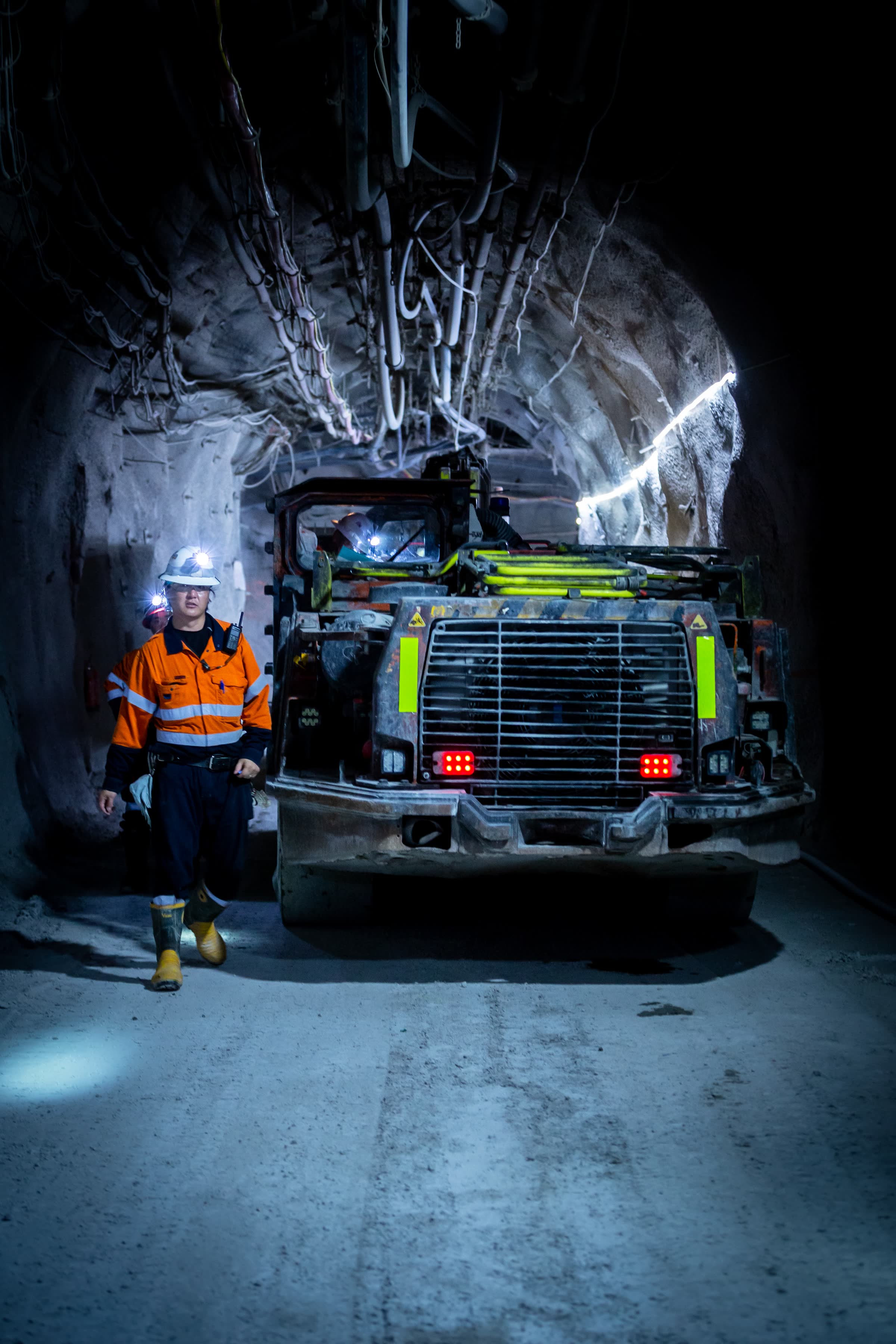
Narrow-reef mining asks compact vehicles to operate on steep and changing ground. Historical extra-low-profile trials reported machines running continually on their brakes, tyres slipping on rims and platforms sliding toward the face. These are productivity problems, but a loss of traction on a dip is first a safety problem.
The RAMMS report A Traction Estimation Digital Twin in Mechanised Mining documents a complete path from that problem to a tested digital-twin architecture.
Why one traction coefficient is not enough
Skid-steered vehicles turn by forcing their wheels to slip laterally. The resistance along the wheel’s rolling direction is therefore not necessarily equal to the resistance across it. Traditional isotropic models assume one coefficient in every direction and can obscure the energy and force needed to turn.
RAMMS developed an anisotropic model that estimates separate longitudinal and lateral traction parameters. Their ratio provides an interpretable measure of turning resistance: a larger ratio means more power is being spent to force the vehicle through a skid-steer manoeuvre.
The physical entity and its measurements
The case study used CMTI Group’s four-ton remote-controlled ultra-low-profile platform, which can carry roof-bolting, face-drilling or dozing equipment. Surface access made controlled testing possible before any underground deployment.
Wheel direction and speed sensors described vehicle motion. Power measurements captured the work done by the driveline. Tilt sensing and LiDAR-based position measurements helped estimate platform pose and movement across the test site. Video became an important independent reference for synchronisation, centre-of-mass calibration and observed slip events.
The digital model
A calibrated Simscape model estimated the normal force on each wheel as the vehicle pose changed. Those wheel loads were combined with measured motion and power in an optimisation procedure that updated the terrain parameters.
The model separated several effects that would otherwise be mixed together: rolling or motion resistance, longitudinal traction, lateral traction and a slip-track term representing the ground disturbed during skid steering.
Surface pull testing supplied an independent check on the longitudinal traction estimate. The measured and estimated values aligned closely enough to build confidence in the anisotropic formulation.
From estimate to action
Traction estimates alone are informative, but they do not yet make the system a digital twin under the RAMMS framework. The report therefore developed two digital-to-physical interventions.
The first predicts slip by comparing available traction with the force demanded at the wheels. The algorithm successfully identified observed slip events and could ultimately be translated into a warning or torque-control action.
The second detects a change in terrain condition. Tests conducted on two days provided different surface conditions, and the algorithm successfully identified when the estimated terrain moved away from its reference. In its current form, it can say that conditions changed; future work is needed to classify whether the change is safer or more hazardous.
What the tests showed
The lateral traction estimate was generally greater than the longitudinal estimate, confirming that the isotropic assumption hides an important part of skid-steer behaviour. The anisotropic model also represented measured power more effectively, especially during manoeuvres dominated by lateral dynamics.
Slip prediction and terrain-change detection both produced promising surface-test results. Together they demonstrate the full twin loop: measurements update an interpretable physical model; the model estimates terrain state; and the estimate supports a warning or control decision.
The next development steps
The report recommends reducing the sensor set and cost, improving real-time model execution, estimating traction at each wheel and replacing the stochastic optimisation step with a more robust state-estimation approach such as Kalman filtering.
It also proposes moving from slip prediction to tested torque control and making terrain classification more interpretable. A fleet-level approach could compare measurements across machines and distinguish a local outlier from a broader change in road condition.
The development roadmap begins with a small dedicated skid-steer test vehicle, where geometry, mass and terrain can be changed quickly and safely. Once calibrated, the methodology can be scaled back to the full CMTI platform and later tested underground.
The broader result is a reusable approach: estimate the part of the machine-environment interaction that cannot be measured directly, expose it in physically meaningful terms and connect it to a safer operating decision.