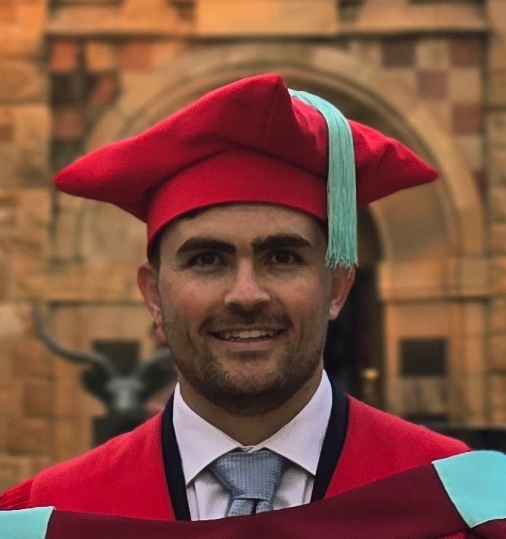
Dr Luke van Eyk has worked in RAMMS since late 2022 as both a programme researcher and, during Phase 1, a part-time PhD candidate. He refocused his doctoral work to align fully with the programme’s mechanised-mining priorities and has helped turn individual modelling studies into a connected digital-twin research portfolio.
Hybrid models for mining equipment
Luke’s doctoral research combines physics-based and data-driven models for mining applications, with particular attention to mobile-equipment drivelines. Physical models provide interpretable structure and allow behaviour to be explored beyond measured cases; data-driven components learn effects that are difficult to formulate or observe directly.
The work is linked to RAMMS studies of diesel engines, LHD dynamics, condition monitoring and collision avoidance. It establishes a common modelling foundation that students can extend for a particular asset or operational decision.
Defining an actionable digital twin
Together with Prof Stephan Heyns, Luke developed a mining-specific framework for defining, designing and constructing digital twins. The framework distinguishes a digital model from a digital shadow or twin by examining its physical entity, synchronised connections, model fidelity, optimisation capability and actionable intervention.
The resulting open-access journal article provides a shared vocabulary and a design process for choosing an appropriate model rather than defaulting to the most complicated one. This principle now runs through RAMMS projects on engines, conveyors, drilling, machine vision and shaft conveyances.
Traction, terrain and vehicle safety
Luke also led the development of a traction-estimation digital twin for a four-ton skid-steered ultra-low-profile platform. The model estimates separate longitudinal and lateral terrain interaction instead of assuming equal resistance in every direction. Surface experiments supported slip prediction and terrain-change detection, creating a path from onboard measurements to warnings or control interventions.
The associated work has been presented to mining and engineering audiences, including the 2025 AMRE Safety Seminar. It connects vehicle dynamics, interpretable estimation and collision-avoidance decisions in steep, low-profile mining environments.
Programme role and current focus
Luke submitted his PhD for external examination at the end of 2025 and continued as RAMMS’s full-time researcher in Phase 2 from January 2026. He supports research planning, student projects, technical reporting, conference communication and industry-facing model development.
His current focus is on digital twins that do more than reproduce an asset: they must estimate a relevant state, show the confidence and physical basis for that estimate, and lead to a decision that a person or control system can act on.