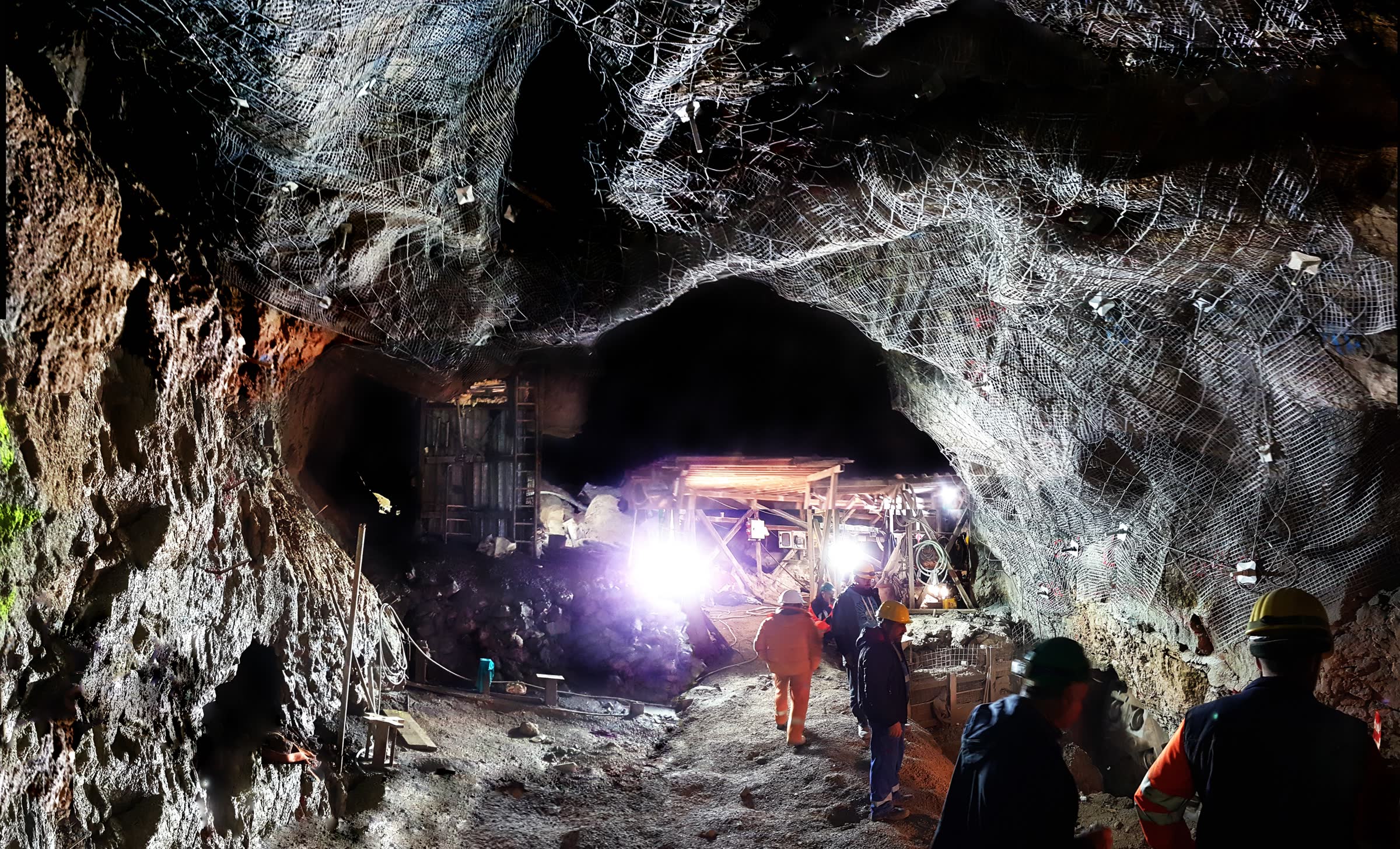
Mechanical cutting could help move narrow-reef hard-rock mining toward a more continuous process, but the design problem depends on how the actual reef responds to a cutting tool.
Ulrich du Preez designed and manufactured a laboratory linear cutting machine, commissioned it with comparatively homogeneous sandstone and then repeated controlled tests on UG2 reef.
The comparison exposed a crucial limitation: similar average trends do not make the materials interchangeable. UG2 showed substantial millimetre-scale variability, a strong influence from cutting depth and persistent fine fragmentation. At a four-millimetre depth, sandstone formed larger fragments while UG2 still produced powder-like material—an important issue for underground cleaning.
Ulrich also calibrated an LS-DYNA continuous surface cap model. It could reproduce one set of cutting conditions after calibration, but did not yet generalise when parameters changed. That limitation gives the next research step its shape: models need to represent heterogeneous rock well enough to remain useful beyond a single test configuration.