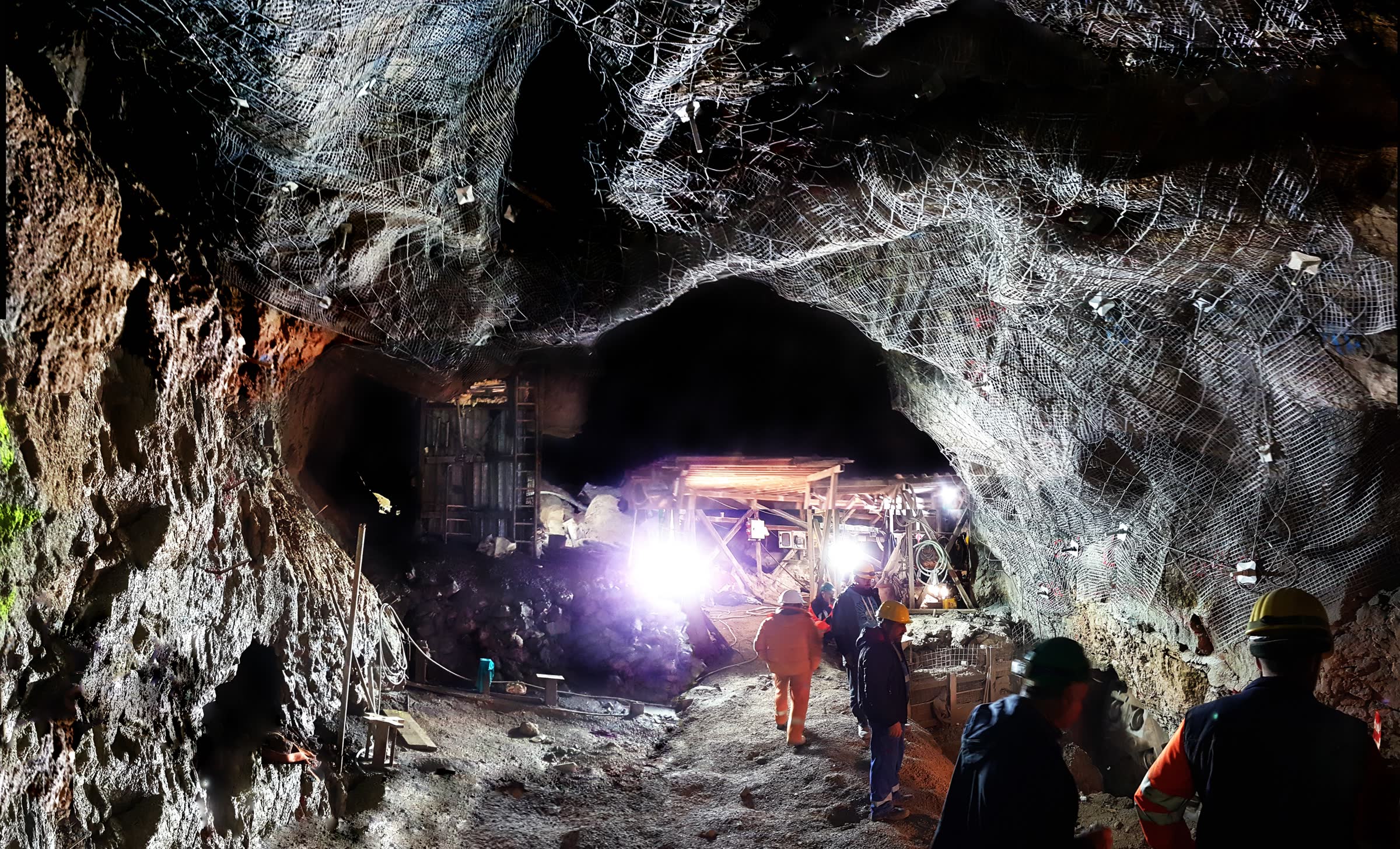
Conventional underground hard-rock mining is organised around a batch cycle: drill, charge, blast, ventilate, clean and support. The blast window creates a rigid boundary. Work completed early may wait idle; work completed late can cause the operation to miss the window and delay the entire cycle.
The draft RAMMS paper Towards Continuous Underground Blasting in Mechanised Mining asks whether mines could reduce that batch constraint before fully mechanical hard-rock cutting becomes commercially practical.
The proposal is not continuous detonation
The paper explores lower-energy, deflagration-based rock breaking. Unlike high explosives, deflagration propagates below the speed of sound. The two technology families examined are pyrotechnic cartridges and carbon-dioxide phase-transition systems.
Because the event is less violent, equipment and people may not need to withdraw as far or for as long as they do for conventional blasting. That creates the possibility of smaller, more frequent breaking events integrated with mechanised drilling, cleaning and support.
The attraction is evolutionary rather than revolutionary. These methods still begin with drilling and charging, so they could potentially be introduced into an existing operation more gradually than a completely new mechanical cutting system.
Where continuity could create value
More frequent rock-breaking events could reduce waiting between activities and make production less dependent on one daily blast. Smaller events may also allow ore and waste sections to be broken separately, potentially reducing dilution.
The paper identifies additional possible benefits:
- less violent breakage could reduce damage to surrounding rock and installed support;
- lower dust and toxic-fume generation could reduce ventilation delays and costs;
- different fragmentation behaviour may reduce fines and associated mineral loss; and
- keeping equipment closer to the face could reduce repeated traffic and interactions between machines and people.
These are hypotheses to be tested, not established performance claims for every mine.
The unresolved questions are substantial
Cost is the largest uncertainty. Published estimates vary widely because material cost, additional drilling, reliability, fragmentation and downstream handling are not always counted on the same basis. A method that appears expensive per hole could still be competitive across the complete production system—or the opposite could be true.
Reliability is equally important. If lower-energy charges require closer spacing or if a misfire forces a complete rework, both cost and cycle time can deteriorate quickly. Larger fragments may also require changes to loading, transport and crushing systems.
The method’s applicability in the deepest and strongest South African hard-rock conditions remains uncertain. Faster advance can also change seismic exposure. Safety, explosives regulation and geotechnical response therefore require mine-specific engineering and formal approval.
A research programme, not an operating recommendation
The report recommends a small-scale comparative trial in an existing underground operation. Conventional and deflagration-based sections could be compared on advance, fragmentation, dilution, ventilation, reliability, downstream cost and safety impact.
It also proposes modelling work. Finite-element or discrete-element models could investigate hole geometry and breakage reliability, while a mine-cycle simulation could test how local differences propagate through transport, ventilation and processing.
Why the draft remains useful
This document is explicitly a draft position paper. It does not claim that deflagration is ready to replace conventional blasting. Its contribution is to reframe the productivity question.
If the batch boundary itself creates the loss, improving each task independently may never produce a continuous system. The research challenge is to test whether a less disruptive breaking event can loosen that boundary without creating unacceptable cost or risk elsewhere.